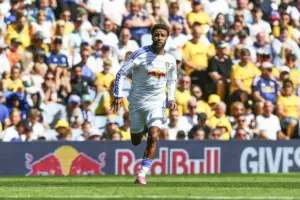
Dominic Calvert-Lewin arrived at Elland Road on a free transfer with a point to prove, and against Newcastle United he delivered the kind of performance that turns fringe conversations into certainties.
A goal, an assist, and a place in Leeds United folklore alongside Mark Viduka: this was not a good night for the striker, it was a statement of intent for the entire club.
The 4-1 demolition of Newcastle was built on intensity, ruthlessness in front of goal, and a centre-forward who now looks tailor-made for Daniel Farke’s system.
Read the full breakdown of that in Leeds United dismantle Newcastle as Farke’s men make a huge statement at Elland Road, but the headline within the headline was Calvert-Lewin’s continued transformation into the leader of the line Leeds have needed for years.
Elland Road Finds Its Ideal No.9 in Dominic Calvert-Lewin
When Leeds signed Calvert-Lewin on a free transfer, the move was framed as low-risk business for a club rebuilding its Premier League identity.
Nine months on, it reads as one of the shrewdest pieces of recruitment in the division. His goal against Newcastle took his tally to three in his past four Premier League outings, form that has coincided precisely with Leeds’ emergence as one of the division’s most difficult sides to beat.
There is also a personal history at play.
Calvert-Lewin has now scored eight times in his career against Newcastle, a record that suggests something beyond coincidence whenever these two sides meet.
Farke’s system, built around quick transitions and a focal point capable of holding up play under pressure, has given the striker a platform his career had lacked in recent seasons.
For a fuller account of how he got here, Dominic Calvert-Lewin Leeds United: The No.9’s Career Explained traces the journey that led to Elland Road.
Leeds’ second goal on the night was not his, and supporters should be clear on that point: the finish was credited to Jayden Bogle after the ball took a final touch off the full-back on its way in.
It mattered little to the scoreline, but it underlined a collective performance in which Calvert-Lewin was the spearhead rather than the sole architect.
Newcastle, unbeaten in their opening five matches of the season in all competitions before this trip to West Yorkshire, were simply overwhelmed, conceding three goals in a 14-minute spell either side of half-time as Leeds’ pressing and directness took hold.
Matching Mark Viduka and Spearheading Leeds’ 2026 Surge
The historical resonance of Calvert-Lewin’s contribution cannot be overstated.
By scoring against Newcastle, he became only the second player in Leeds United’s history to find the net in five consecutive Premier League appearances at Elland Road, matching a club record set by Mark Viduka, one of the most revered strikers to wear the shirt in the Premier League era.
For a fanbase steeped in the memory of Viduka’s technique and finishing, the comparison is not made lightly.
That individual milestone sits inside a broader story of collective transformation.
Leeds have accumulated 35 Premier League points in 2026, a return bettered by only Arsenal, Manchester City, Manchester United and Bournemouth.
It is a table that places Farke’s side firmly among the division’s genuine overachievers, and it has been built on defensive resilience as much as attacking firepower. Leeds have lost just once in their past 13 Premier League matches, a run of consistency that has quietly repositioned the club’s ambitions for the remainder of the campaign.
Jayden Bogle’s contribution to the win, deflected goal included, is a reminder that this Leeds side is not a one-man operation.
His performance against Newcastle is examined in detail in Jayden Bogle shines as Leeds United make Newcastle statement, and it fits a wider pattern of players across the pitch elevating their output alongside their new No.9.
Daniel Farke’s Verdict and the Statistical Proof Behind the Form
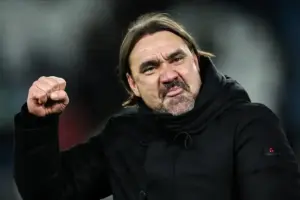
Farke has watched Calvert-Lewin’s evolution up close since his arrival, and his post-match assessment left little room for ambiguity about the striker’s importance to the team’s structure.
“He’s a handful and tough for each and every defender. He’s difficult to play against. He’s at a top fitness level. You can see he plays with confidence and a good rhythm, but also benefits from a really strong team and players who work for him. Dominic is a crucial player and if he shows this type of form, he’s definitely one of the best strikers in this league. It’s the best league in the world and that more or less sums up what I think about him as a player,” said Farke.
That verdict is echoed in the numbers. Three goals in four league games, a goal and an assist against a Newcastle side chasing European qualification, and a shared club record with Viduka are not the marks of a player rediscovering his level by accident.
They point to a system that suits him and a manager who has designed his attack around his strengths. Farke’s fuller reflections on the performance are collected in Daniel Farke hails Leeds United’s “top-class” Newcastle performance.
From the opposite technical area, Newcastle head coach Matthias Jaissle offered a blunt admission of where the game was lost.
“I don’t want to point fingers and point any players out tonight. We were not matching as a team the level of intensity, the level of duel behaviours, the level of physicality. This is something we need to bring on the pitch in every match. This is non-negotiable. It should be the basic fundamentals of football. These are young lads. The learning curve needs to be fast,” Jaissle said.
His words, reported in the BBC Sport report on Leeds United’s victory against Newcastle United, confirm just how comprehensively Leeds’ physical approach dictated the contest.
Saudi Moves and England Picture: What Comes Next for Calvert-Lewin
Calvert-Lewin’s resurgence carries an extra layer of context given who was overlooked when England’s senior squad required cover at centre-forward.
Both Ivan Toney and Ollie Watkins travelled as Harry Kane’s deputies to the summer World Cup ahead of him, and both have since moved into club football in Saudi Arabia. Calvert-Lewin, by contrast, remained in the Premier League and answered a March call-up by featuring for England against Uruguay.
The contrast is instructive without needing embellishment. While two of his rivals for the England striker’s shirt have taken lucrative moves away from Europe’s top flight, Calvert-Lewin has stayed and rebuilt his reputation in the country’s toughest league, at a club whose trajectory now mirrors his own.
Nothing beyond his March appearance against Uruguay has been confirmed regarding his international future, and any further selection remains a matter for the England set-up rather than speculation here.
What is beyond dispute is the shape of the story unfolding at Elland Road.
A free transfer has become a statistical and symbolic centrepiece of Farke’s Leeds project, a striker matching club legends and outperforming international rivals who chose different paths.
With 35 Premier League points banked and one defeat in 13, the question for Leeds supporters is no longer whether Calvert-Lewin belongs in this division. It is how much further he, and this Leeds side, can climb.