Elland Road has been Leeds United’s home for more than a century, and for visiting teams it remains one of the least welcoming afternoons in English football. Ahead of another Premier League season at the ground, here is the full explainer: the capacity, the four stands, the record crowd, and the history that made the place what it is.
Elland Road capacity and where it sits in the Premier League
Elland Road holds just over 37,000 supporters, which puts it in the middle of the Premier League pack — smaller than the 60,000-plus arenas in Manchester, north London and on Merseyside, but comfortably bigger than several top-flight grounds. What the raw number does not capture is the shape of the place. The stands sit close to the pitch, the roofs are low at three corners, and noise has nowhere obvious to escape. That is why away managers so often talk about the atmosphere rather than the dimensions.
Every seat is taken for most league fixtures, and the club has been open about wanting to expand. Owners 49ers Enterprises, who completed a full takeover of the club, have publicly discussed increasing the capacity, though supporters should treat any specific figure as provisional until the club confirms it. Nothing about the current bowl changes for now.
The four stands at Elland Road explained
The ground is made up of four stands, two of which carry the names of Leeds legends.
- The West Stand — the main stand, running the length of the pitch, housing the dressing rooms, the tunnel, the dugouts and the press area.
- The East Stand — opened in 1993 and, at the time it was built, the largest cantilever stand in the world. It is the biggest single stand at the ground and holds the largest share of the capacity.
- The Don Revie Stand — the north end, renamed in honour of the manager who turned Leeds from a Second Division side into one of the most feared teams in Europe.
- The John Charles Stand — the south end, named after the Gentle Giant, still regarded by many as the finest all-round footballer the club has ever produced. Away supporters are housed in the corner between the John Charles and West stands.
The naming matters here more than it might elsewhere. Leeds have never been shy about their history, and putting Revie and Charles on the fabric of the stadium is part of how that history is kept in front of every generation of supporter who walks through the turnstiles.
A ground older than the club itself
Here is the detail that surprises most newcomers: Elland Road is older than Leeds United. The site staged its first sport in 1897, when it was used by Holbeck Rugby Club. Football arrived with Leeds City, who took it on in 1904. When City were wound up in 1919 over irregular wartime payments, a new club — Leeds United — was formed and inherited the ground. It has been home ever since, which means Elland Road has now watched well over a hundred years of football on the same patch of south Leeds.
The peak came under Revie. Through the late 1960s and early 1970s, Leeds won league titles, an FA Cup, a League Cup and two Inter-Cities Fairs Cups, and Elland Road became a genuinely intimidating European venue. The high-water mark of the modern era arrived three decades later, when David O’Leary’s young side reached the semi-finals of Europe’s biggest competition — a run covered in full in our guide to Leeds United’s 2001 Champions League campaign.
The record attendance at Elland Road
The largest crowd ever recorded at the ground is 57,892, for an FA Cup fifth-round replay against Sunderland in March 1967. That figure will never be beaten. Elland Road was still substantially terraced in the 1960s, and the all-seater requirements that followed the Taylor Report permanently reduced what the ground could hold. Modern sell-outs are a little over 37,000, and the capacity has not approached the 1967 mark since.
The ground has also worked well beyond club football. It has staged England internationals, hosted group matches at Euro 96, and put on rugby league Test matches and concerts — a reminder that Elland Road has long been treated as a major national venue rather than simply a club stadium.
Sold, then bought back
One chapter still stings. During the financial collapse that followed the O’Leary era, the club sold the freehold of Elland Road in 2004 and became tenants in their own ground, paying rent to outside landlords for well over a decade. The stadium was finally bought back in 2017, restoring ownership to the club. For supporters who lived through the administration years and the long stretch outside the top flight, that repurchase was as significant as anything happening on the pitch.
What matchday sounds like
Elland Road’s reputation rests on volume. Marching on Together before kick-off, sung by the whole ground, is one of the most recognisable pre-match rituals in English football, and the noise tends to arrive in waves rather than as constant background hum — sharp, sudden, and loudest when Leeds press. It is a large part of why the club’s home form has so often outstripped its away record.
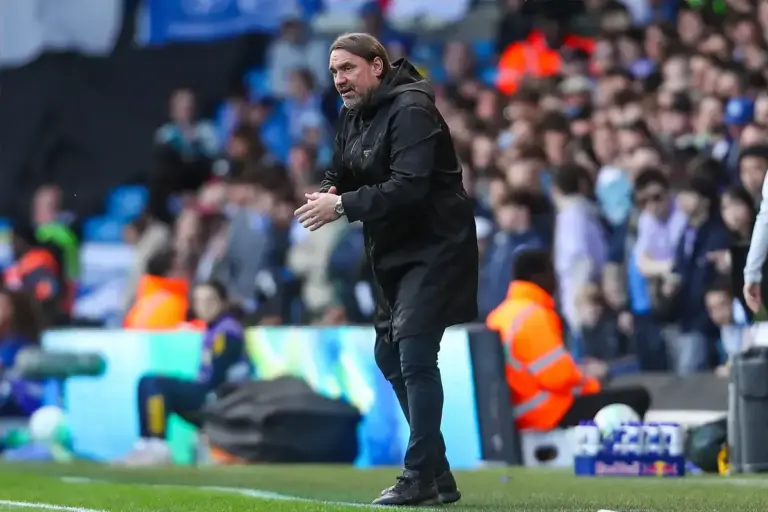
That is the setting Daniel Farke‘s side works in this season, with Ethan Ampadu leading them out as captain in front of a full house. Fixtures, ticket details and official stadium information are published on the club’s official website, while broadcast selections and kick-off times are confirmed through the Premier League.
The stands have been renamed, the terraces have gone and the ownership has changed hands more than once. The address has not. If you want to understand why Leeds supporters talk about their ground the way they do, that continuity is the whole answer.