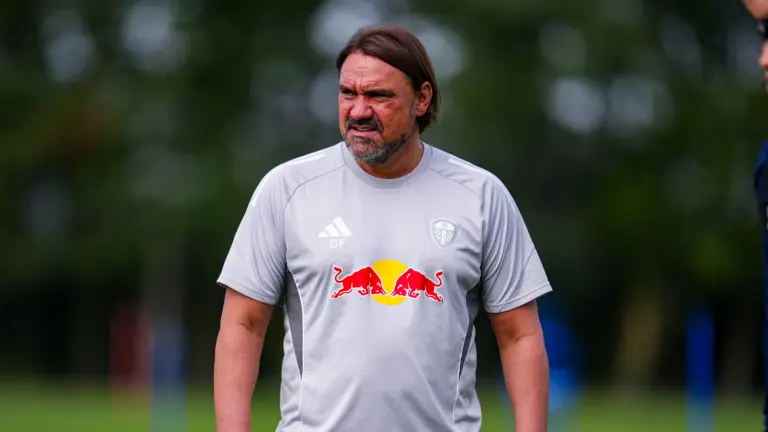
Elland Road has not sounded like this in years.
Leeds United’s 4-1 demolition of Newcastle United has lifted Daniel Farke’s side to third in the Premier League, and the eight points collected from their opening four fixtures represent the club’s best start to a top-flight campaign since 2001-02.
For a support that has spent much of the last two decades braced for disappointment, this is uncharted territory.
Elland Road Believes Again as Leeds Enjoy Historic Start
The scoreline against Newcastle told its own story.
Leeds were ruthless in dismantling Newcastle 4-1 at Elland Road, a result that has propelled them into the top three and set social media alight with talk of a top-four tilt.
There is a temptation among some supporters to treat this as a novelty, a hot streak that will inevitably cool. But scratch beneath the surface and the picture looks less like fortune and more like design.
Third place after four games means little in isolation. What matters is the trajectory. Leeds have not simply stumbled into form; they have built towards it methodically since the turn of the year, reshaping both their tactical identity and the physical profile of their squad.
Farke, whose position was reportedly under scrutiny only months ago, now finds himself presiding over the club’s most encouraging top-flight start in a generation.
Farke’s Tactical Shift and Summer Physicality Blueprint
The pivot point can be traced to a specific afternoon.
Trailing at half-time against Manchester City on 29 November, Farke abandoned his back four and switched Leeds to a back three.
That in-game decision has since hardened into the team’s default shape, offering greater control in midfield and a more secure defensive base against Premier League opposition that regularly overloads wide areas.
Farke has been open about the thinking behind the club’s recruitment strategy, which was designed with exactly that kind of physical examination in mind. Eight of Leeds’ ten permanent summer signings stand over six feet tall, a deliberate response to the aerial and physical demands of English top-flight football.
“I wouldn’t say it’s coincidence that they are all tall players but, of course, if you join the Premier League and you have one of the smallest groups, you expect that probably there is more pressure on you than there was in the Championship.
“You have to make sure that you’re also good in defending crosses.”
That recruitment drive addressed two problems at once. Tarik Muharemovic and Nico Elvedi arrived to rebuild the centre of defence after Pascal Struijk’s departure to Brighton, giving Farke the aerial presence and composure needed to play out from a back three under pressure.
Nico Elvedi has already settled into the demands of English football, and he praised the Elland Road atmosphere after the Newcastle victory.
Between the posts, James Trafford’s £40m arrival from Manchester City has given Leeds a goalkeeper capable of commanding his box amid the sort of crowded penalty areas that undid previous incarnations of this side.
Further forward, Harry Wilson’s free transfer from Fulham has added craft and physical resilience without the outlay a fee would have required.
Nowhere is the benefit of the taller profile clearer than in support of Dominic Calvert-Lewin, whose hold-up play thrives when he is not the lone physical presence in the final third. The forward has embraced playing alongside a similarly built supporting cast.
“I enjoy having bodies around me.”
Farke praised Leeds United’s performance against Newcastle as evidence that the tactical and recruitment groundwork laid over the past year is now bearing fruit in the Premier League proper.
Five Losses in 29 Games: The Numbers Behind Leeds’ Surge
The Newcastle rout is not an isolated data point. It sits within a run stretching back to 3 December, when Leeds beat Chelsea at home and effectively began the sequence that underpins their current confidence.
Since that victory, Leeds have lost only five of their 29 league matches, a record that few outside the traditional elite can match over the same span.
Calvert-Lewin’s numbers form the sharpest illustration of that turnaround.
He has scored 14 top-flight goals since last December, a return that places him among the most prolific forwards in the division over that period and vindicates the decision to build the attack around his physicality and movement.
The back three has been central to the defensive side of that equation. Muharemovic and Elvedi have given Farke the option to defend with a spare man against direct opposition, while Trafford’s distribution and shot-stopping have reduced the errors that previously cost Leeds points in tight matches. None of this happened overnight; it is the product of a tactical adjustment made almost a year ago now showing its full effect against genuine Premier League quality.
Context matters here too. Leeds are not simply riding a favourable run of fixtures. Newcastle arrived at Elland Road as a side with genuine European ambition, and dismantling them by three clear goals suggests the underlying performance level, not just the results column, has shifted.
Can Leeds Maintain Top-Four Pace Through the Winter?
It is worth remembering how fragile this position looked only a matter of months ago.
According to reports cited by BBC Sport, Farke was in real danger of losing his job during the early part of the 2025-26 season after Leeds lost eight of their opening 13 league games.
Those reports were never confirmed as club policy, and Leeds have not commented publicly on any such deliberations, but they illustrate how quickly the mood at Elland Road has turned. Anyone wanting the fuller picture of Daniel Farke’s contract situation can find the background there.
The question now is whether this is a genuine platform for sustained top-four contention or a purple patch that flatters a squad still adjusting to Premier League life.
Eight points from four games and five defeats in 29 offer real statistical weight, but a congested winter schedule, with its fixture pile-up and injury risk, will test the depth Farke has assembled far more severely than four matches can.
What is beyond dispute is that the ingredients for a longer run are in place: a settled tactical shape, a squad rebuilt for Premier League physicality, and a manager whose job was reportedly under threat now reaping the reward of patience shown by the club’s hierarchy.
For a full breakdown of the data behind these numbers, supporters can consult the original BBC Sport report on Leeds United’s transformation.
Whether Leeds can turn their best start in 24 years into something more permanent will define how this season is remembered at Elland Road.
The evidence so far suggests supporters are entitled to dream, even if the winter months will provide the sternest examination yet of Farke’s rebuilt side.