Ask three Leeds supporters what the club is called and you may get three answers. The Leeds United nickname question has more than one correct response, because the club has collected several over a century — some chosen, some inherited from a pub, and one handed over by opposition fans as an insult that Elland Road simply kept.
Here is where the Whites, the Peacocks and Dirty Leeds all came from, and which of them supporters actually use.
Why Leeds United are called the Whites
This is the one that sticks, and it is younger than most people assume. Leeds United were formed in 1919, after the previous city club, Leeds City, was wound up by the Football League over illegal payments made to players during the First World War. For the first four decades of their existence the new club did not play in all white at all. Blue and gold, and blue-and-white stripes, carried Leeds through the 1920s, 30s, 40s and 50s.
The change came with Don Revie. Appointed player-manager in March 1961 with the club sliding around the Second Division, Revie switched the kit to all white in deliberate imitation of Real Madrid, then the dominant force in European football. It was pure psychology — dress like the best side on the continent and start behaving like them — and it is difficult to name a rebrand in English football that aged better.
The white shirt outlived Revie, the trophies and several relegations. It also happens to sit neatly alongside the white rose of Yorkshire, which is why the association feels older than 1961 even though it is not. Sixty-five years on, the current squad still runs out at Elland Road in the shirt Revie chose.
The Peacocks: the oldest Leeds United nickname of the lot
Long before the white kit, Leeds were the Peacocks — and the reason has nothing to do with football. Elland Road was laid out in 1897 as the home of Holbeck Rugby Club, and the ground took its informal name from the Old Peacock, the pub that still stands across the road. It was widely known as the Old Peacock Ground, and when football took the site over, the nickname came with the deeds.
Leeds City moved in around the turn of the century, Leeds United inherited the ground in 1919, and the Peacocks tag simply carried on. It is used less than the Whites in everyday conversation, but you will still see it in club histories, in matchday programmes, and in the name of the pub itself — the Old Peacock remains one of the busiest pre-match spots in LS11.
Dirty Leeds: an insult that became a badge
The third nickname was not a gift. Revie’s side of the mid-1960s and 1970s were extraordinary footballers — two league titles, an FA Cup, two Inter-Cities Fairs Cups, a European Cup final — but they were also relentless, streetwise and, by the standards of the day and the reporting of it, cynical. Rival supporters and much of the national press settled on “Dirty Leeds”, and it followed the club for decades after the players had retired.
What happened next is familiar to anyone who has watched a fanbase absorb an insult. Leeds supporters largely stopped arguing with it and started wearing it. It appears on flags, on T-shirts and in terrace songs, generally with a raised eyebrow. The Revie era is remembered in West Yorkshire as “Super Leeds” — the phrase that echoed round Elland Road at the time — but Dirty Leeds is the one the rest of the country remembers, and the club has long since stopped apologising for it.
Marching on Together, MOT and the rest
Not every Leeds phrase is a nickname, but a few get treated as one. “Marching on Together” is the club anthem, written for the 1972 FA Cup final and released as the B-side to a single called Leeds United; Leeds beat Arsenal 1-0 at Wembley that afternoon and the song has been sung before kick-off ever since. It is abbreviated to MOT so routinely that the three letters function as a greeting, a sign-off and a shorthand for the whole club.
“Super Leeds”, as above, belongs to the Revie years. “LUFC” is simply the initials. And “the Whites” is what commentators, reporters and supporters actually say — the others are for history books and banners.
Which Leeds United nickname should you use?
The Whites, almost always. It is the one in common use, it is understood everywhere, and it points at the most recognisable thing about the club: the plain white shirt Revie borrowed from Madrid and never gave back.
The Peacocks is the connoisseur’s choice, and worth knowing if you want to understand why a pub in Beeston keeps appearing in the club’s story. Dirty Leeds is best left to Leeds fans themselves — it lands very differently depending on who says it.
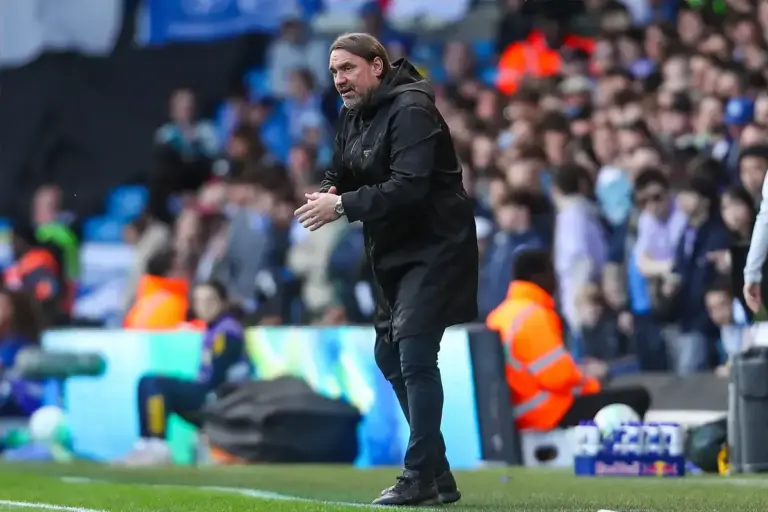
All of which still matters on a Sunday afternoon. Daniel Farke’s side, captained by Ethan Ampadu, are into a second successive Premier League season and start their home campaign at Elland Road, in white, in front of a crowd that will sing Marching on Together before a ball is kicked. If you want the current picture, our guide to the confirmed Leeds United squad numbers for 2026/27 lists every player in that shirt, and the 2001 Champions League run explains the last time the Whites made Europe take notice. The club’s own official website carries the full club history for anyone who wants to go further back than Revie.